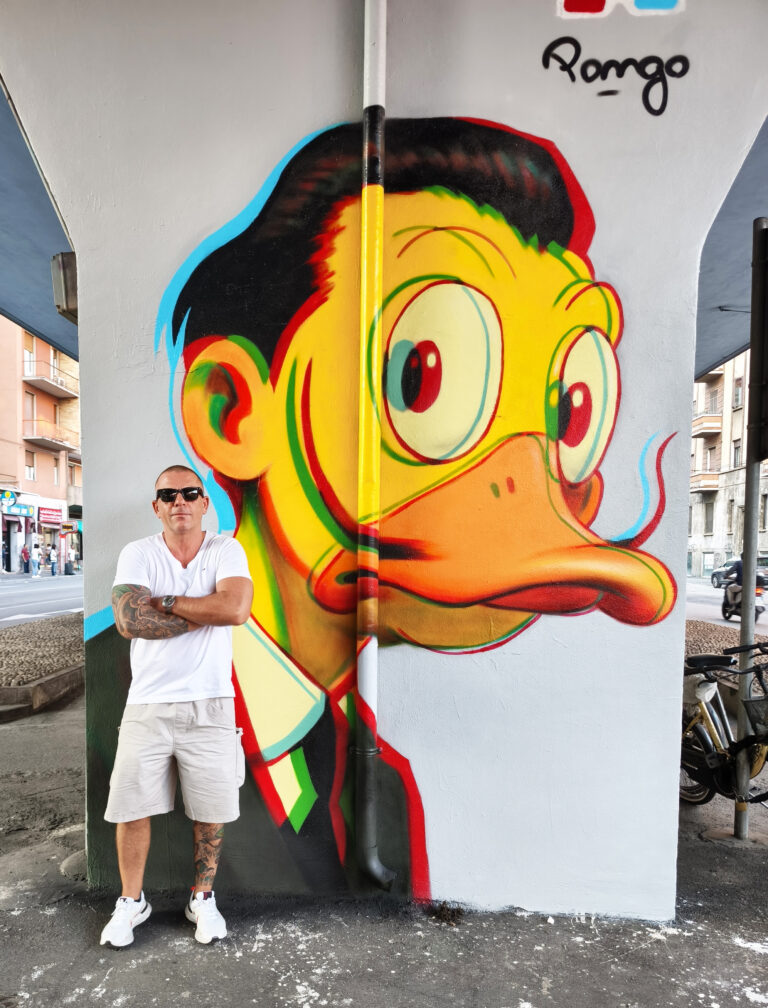
Pongo Biography and Painting Concepts
Around the mid-1980s, during a work stay with his father in New York, he encountered street art.
After graduating from art school, his desire to "scratch" the city's skin in urban and suburban spaces grew stronger.
He chose a name: Pongo.
PONGO is a “wildstyler” and as such he researches, designs and evolves the structures of the letters, of the writing and of the metropolitan images.
He paints on all surfaces, with a particular attraction to trains and subways, but without neglecting the large walls of suburban areas, becoming one of the most prominent figures in Italy.
Very active both in Milan and at international level, he has taken part in gatherings and events throughout Europe while his links with the N.Y.C.’s scene became stronger. Becomes a member of the TNBs and undertakes an artistic alliance with the TATs, very famous historical groups already present on the New York scene as from the '70s and considered the pioneers of.
His street writing activity lasts several years, until 2000.
Despite his frequent travels to the U.S. and collaborations with his New York colleagues, his painting on canvas and other materials goes through various phases.
Following the turn of the new millennium, he entered a period of reflection, shifting his interests toward philosophical research and the nature and sustainability of life on our planet. Today, he uses painting to make artistic choices that are beneficial for his own and others' human growth, without forgetting his frontier experiences, consistent with his past in Public Art.
In 2013, he presented his solo exhibition PONGO: WITHOUT TRUTH-GRAFFI AL FUTURO SENZA VERITA at the Pow gallery.
The last century was a rush of changes in the social, scientific, and cultural fields. Twentieth-century art opened a debate on the traditional way of seeing and representing the world. Pongo, at the end of the century, questioned reality itself and the canonical boundaries of various movements. An incandescent explorer of international metropolitan graffiti, son of generations of artists and a rebellious artist, he pursued the utopia of erasing the ugliness of peripheries poisoned by decay with spray paint in New York, Rio, Paris, and Milan. With the turn of the new millennium, Pongo entered a new phase in his work. Through his exclusive artistic research, balanced between environmentalism and technology, he managed to weave an original Ariadne's thread between his personal experiences, the culture of the past, and a future he perceives as increasingly ambiguous.
In the first phase of the new millennium, Pongo scratches the future to affirm that there will be a future, revealing the extreme effects of the obtuseness of world governments. He makes visible the possible consequences of the systems that produced them. No longer graffiti as a pressing invitation to raise awareness regarding urban degradation, but rather scratching at the planet's dilapidated future habitat. Pongo displays an extreme rebellion against consumer society and the idea of infinite development.
Unlike the Cubists who attempted to mimic the normal visual process of the eyes, synthesizing the observation of objective reality from multiple points of view and in a conceptually dissimilar way to Jackson Pollock, who, according to the well-known uptown critic Clement Greenberg, instinctively produced the theory of “flat surface” with Action Painting, Pongo is aware of living himself in the reality of the flat, globalized world, where the present and future flow on a treadmill. Thomas Lauren Friedman, a well-known American commentator, has described globalization as a phenomenon of world flattening due to historical-political-technological forces that allow access to information through boundless operational technological means, but we have no certainty that what we see and hear is truth. With the ’Frame" series from 2013, Pongo scratches the future, territories that unfold frame by frame. Forms that can be experienced in multiple ways, following numerical traces, but with the awareness of witnessing highly personal eventualities. He creates out-of-focus successions of parallel planes of tangibility that can take on three-dimensional consistency, expressing the enigmatic power of cryptic signs, recurrent symbolic traces with an almost esoteric meaning. His is a journey into space that annihilates time. This creates a precarious work of art that can be shared in the analysis of the viewer. Pongo tells us that the quality of time in which we live in constrain us to a constant present/future without truth. Pongo is fascinated by the elusive concept of infinity. Physics teaches us that even a small piece of infinity is always as large as infinity itself. Comprehending infinity requires a deep act of abstraction, because this world does not exist in reality; it exists as a product of our mathematical intellect. The topography of his paintings is meant to be read as a map on an onboard computer that elicits reflection. The images in these works present a kind of apocalyptic situation, like one that could be caused by an oil spill or a nuclear explosion, but they are also images that foreshadow rebirth. History, as we understand it, capable of satisfying our human need for certainty – the irreversible succession of unrepeatable events – does not exist.
Pongo today slipped into a different scan.
Passing through the 2020 Reborn series where the transition between the previous period and the next pictorial period is evident.
From ethical thinking directed at the planet to the search for possible survival, today it has shifted to iconic reinterpretations that are apparently more fun and lighthearted.
Ducks transformed into pictorial subjects that reference famous iconic portraits from history and art are commonly referred to as appropriations, and this is where the value of Pongo 3D's new works lies, operating on different planes and readings.